From a 36-server sprawl to a 20-node Catena cluster
A Northern European IPTV operator replaced 36 hand-managed Flussonic Media Server nodes with a Catena cluster — the same 80,000 viewers and 163 channels, 70% less operations time, and 100 Gbps delivery.
Our Client
Company
A regional IPTV operator in Northern Europe
Industry
Telecom / IPTV
Challenge
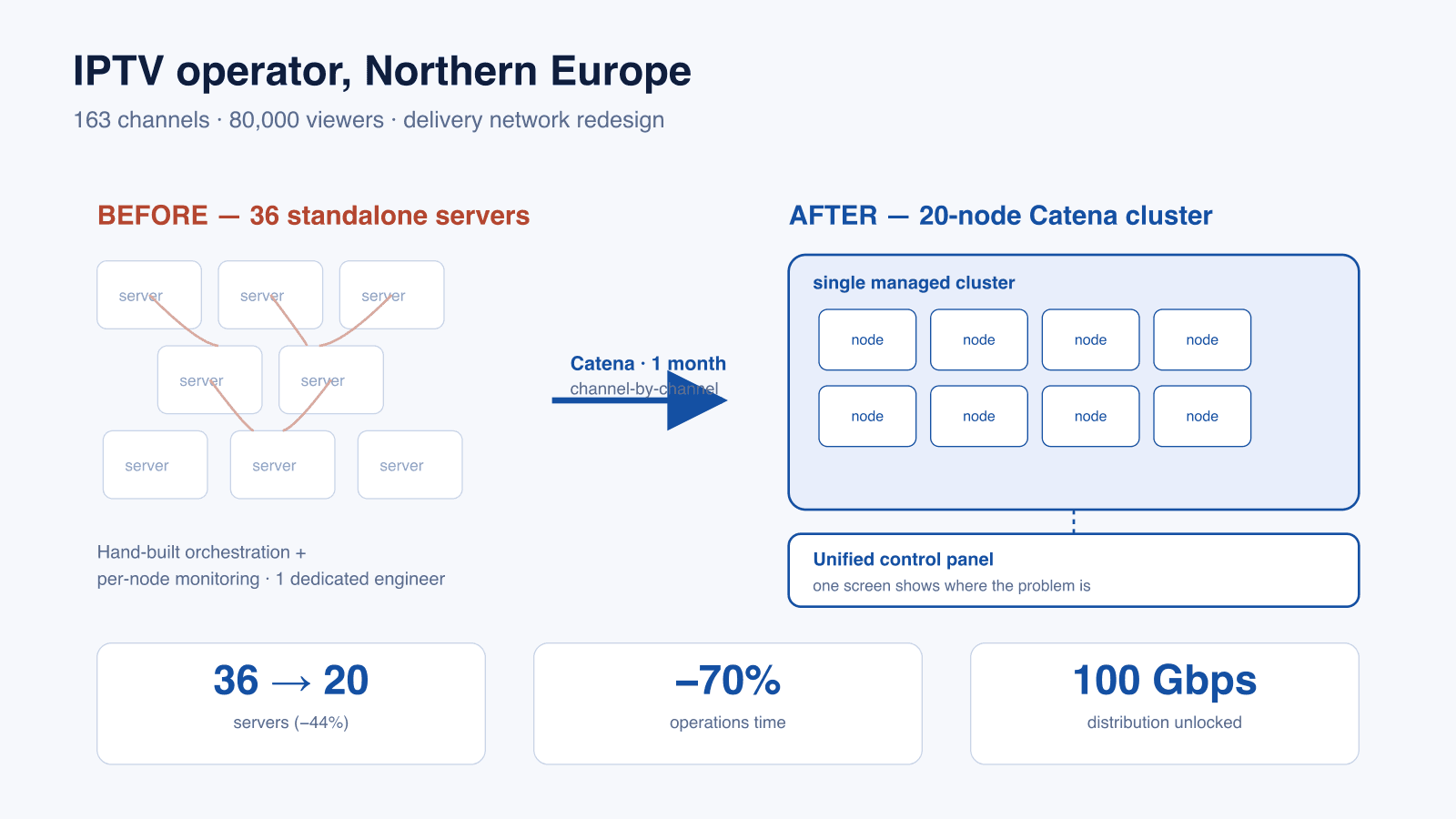
The operator delivered 163 live channels to 80,000 viewers from regional points of presence on 36 Flussonic Media Server nodes. With no native clustering, the team had hand-built every piece of the orchestration themselves — distributing servers across regions and monitoring each node independently. Running it took a dedicated engineer, and when something went wrong, finding the cause meant logging into server after server.
Key Results
- •36 to 20 servers (~44% fewer nodes) for the same 163 channels and 80,000 viewers
- •70% of the operations engineer's time freed
- •A single pane of glass that points straight to a problem — no more walking 36 servers
- •100 Gbps distribution capacity unlocked
- •Channel-by-channel cutover completed in about a month, with no service interruption
About the Project
Client's Goal
Keep serving 80,000 viewers and 163 channels reliably while cutting the operational weight of a sprawling, hand-managed estate — and be able to grow without rebuilding the wrapper each time.
Our Solution
The operator replaced the 36-node Flussonic Media Server estate with Catena, Flussonic's cluster-first TV delivery platform. Catena runs the 163 channels as a single managed cluster: capacity, failover, and monitoring are native instead of hand-coded. A unified control panel replaced the patchwork of per-node checks, so an incident is located in seconds rather than server-hops. The migration was done gradually, channel by channel, over roughly a month — viewers were never taken offline.
Results
Key Achievements
- •Node count cut from 36 to 20 through higher per-node efficiency — the same 80,000 viewers and 163 channels on a much smaller footprint
- •Operations time dropped by 70%: one panel shows where the problem is, instead of 36 separate dashboards
- •100 Gbps distribution installations became possible — dense, high-throughput delivery the old sprawl could not sustain
- •The cluster now scales by adding nodes, not by rewriting custom orchestration
"An incident used to mean opening 36 dashboards. Now a single panel tells us where the problem is — and the person who owned that work has 70% of their week back." — Operations lead, Northern European IPTV operator
Want a similar setup?
Tell us about your project — we'll size the architecture and send you an estimate.
Learn more about Catena