From a spreadsheet of recorder IPs to one pane of glass for 500 restaurants
A restaurant chain with 500 locations replaced a spreadsheet full of recorder IPs with Watcher NVR — every camera records locally, the center sees everything, and investigation time dropped 3x.
Our Client
Company
A restaurant chain with 500 locations
Industry
HoReCa / retail
Challenge
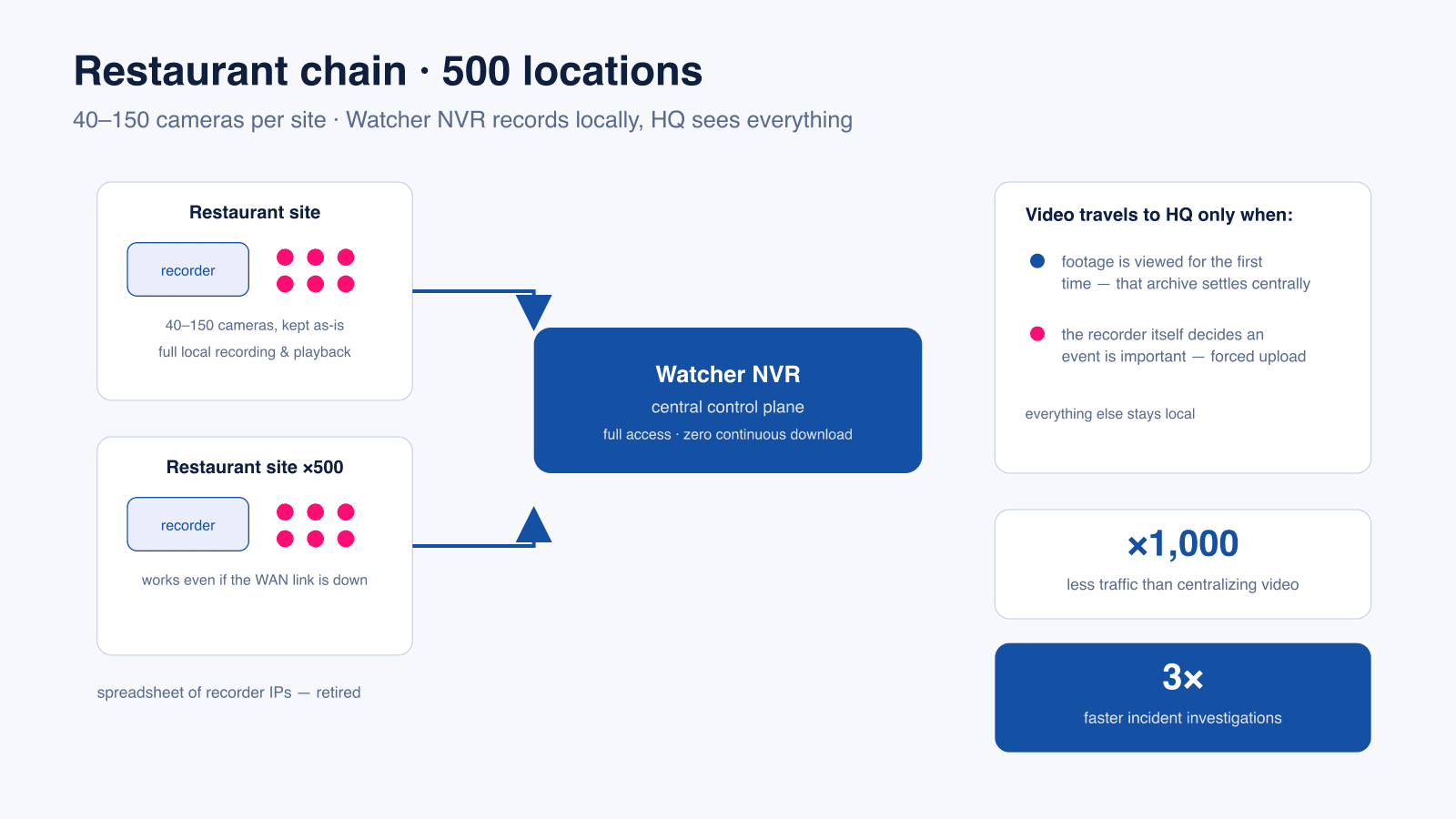
Each restaurant runs 40 to 150 cameras depending on its size, recording to local DVRs — larger sites have several, each with its own IP address. The headquarters team needs footage to resolve conflicts in the kitchen and with guests, and the tool for that was… a spreadsheet listing the IP of every recorder. Pulling all video into a central archive was never an option: a restaurant is not an IT company, and provisioning 100-gigabit links to every site would be absurd. So investigations meant logging into recorders one by one, over slow links, hoping the archive was still there.
Key Results
- •Network traffic cut 1,000x compared with centralizing all video
- •Incident investigation time 3x faster thanks to transparent access to remote archives
- •No cameras replaced — Watcher connected to everything already installed
- •500 locations, 40–150 cameras each, all visible from a single central console
- •Full local functionality at each site, even when the central link is down
About the Project
Client's Goal
Resolve incidents in any of 500 restaurants quickly, without paying to haul continuous video from every camera to a central site.
Our Solution
Each location got a Flussonic Watcher recorder that records everything locally — the site keeps full local functionality regardless of the central connection. At headquarters, the Watcher NVR control plane sees every local recorder and all the content on them: the operator has full access to all cameras, while no physical download happens. Video actually travels to the center in two cases only: when someone watches footage that has not been viewed before (that archive then settles at the center), and when a recorder itself decides an event is important enough to force an upload. The existing cameras stayed — Watcher connected to all of them as they were.
Results
Key Achievements
- •Traffic dropped 1,000x relative to downloading all video centrally
- •Investigators resolve incidents 3x faster — the remote archive is transparently available from one console
- •Zero camera replacement: Watcher works with the cameras the chain already had
- •Important events reach the center automatically, so evidence is safe even if a site's hardware is damaged
- •The spreadsheet of recorder IPs is retired
"We can finally get to the bottom of an incident." — Security operations lead, restaurant chain
Want a similar setup?
Tell us about your project — we'll size the architecture and send you an estimate.
Learn more about Watcher